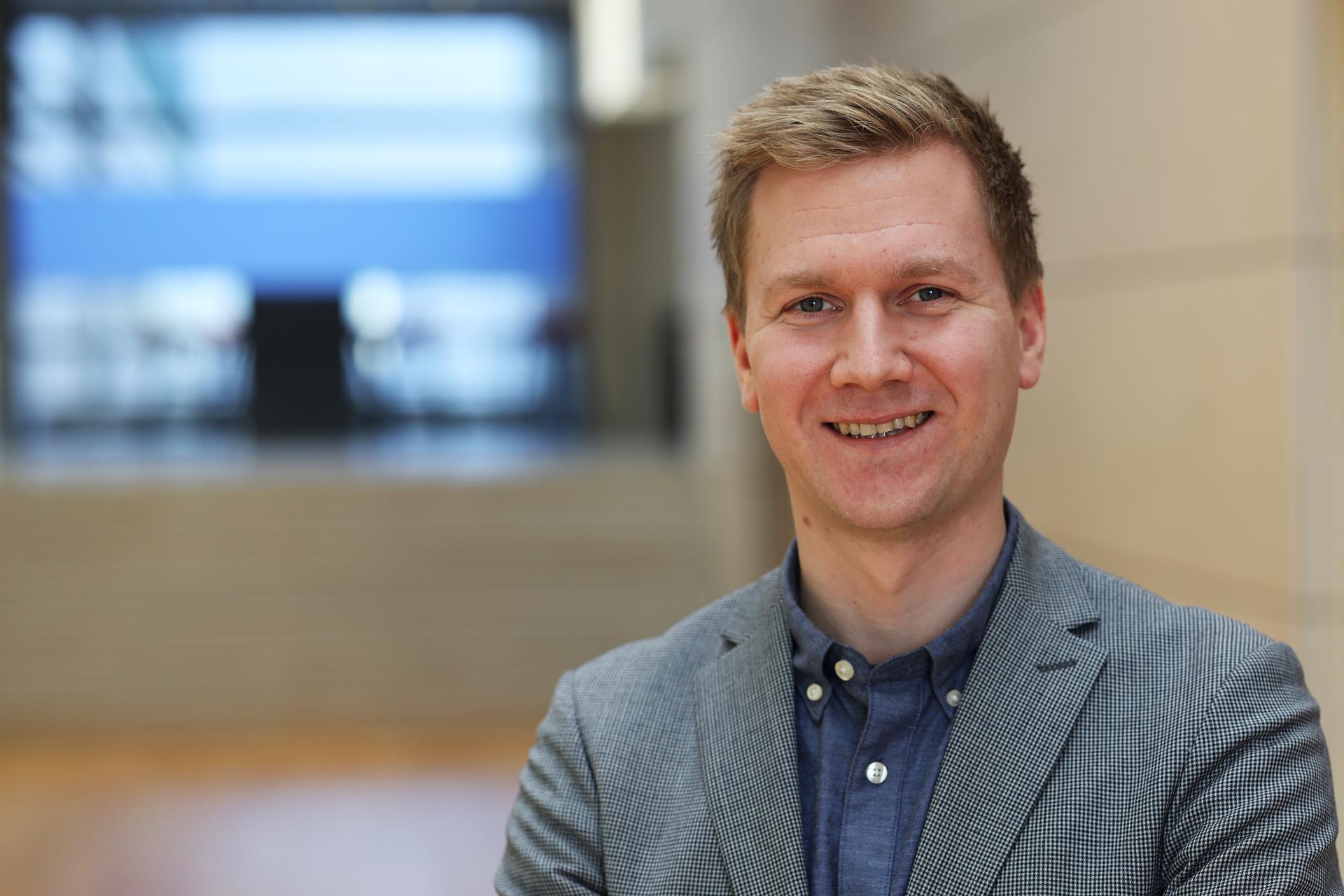
Johannes Bjerva is originally from Norway, but left home at the age of 18 and has lived in both Sweden and the Netherlands. He studied in Stockholm, completed his PhD in Groningen and held a postdoctoral position at the University of Copenhagen before joining Aalborg University in Copenhagen. Today, he is a professor of NLP, head of the Copenhagen section and head of the AAU-NLP research group.
“When I came to Denmark after my PhD, it felt in some ways like coming home. Even so, it took a few years before I started speaking Danish. Initially, I worked in a very international environment where English was the everyday language.”
In 2020, Johannes joined the Department of Computer Science at Aalborg University in Copenhagen as a tenure-track assistant professor. Around the same time, he decided to start learning Danish. For him, it was a way to engage with life in Denmark and settle into the country he now called home.
“The Danish-speaking environment gave me a good opportunity to learn the language, and it made a real difference to my sense of belonging. I find that you get to know people in a different and deeper way when you speak their language. For me, it has also been a way of engaging with the country I have chosen to live in. That was how I felt about Dutch, and it is how I feel about Danish. At the university, speaking the language has also opened up more opportunities to get involved in shaping the workplace.”
A New Area of Research
Johannes explains that he has always been very interested in languages. Halfway through his studies, he discovered that there was an entire field of research devoted to the automated analysis of language: Natural Language Processing (NLP), and more specifically the branch known as computational linguistics.
When Johannes joined AAU in 2020, there was no NLP research at the university, but much has changed since then.
“My first project funded by the Carlsberg Foundation, Multilingual Modelling for Resource-Poor Languages, has been particularly significant. It marked a turning point: from being the only person working in my research area to being able to build the NLP group we have today, with around twenty people.”
Choosing AAU was also a strategic decision, giving him the opportunity to try to build something entirely new, both in teaching on the Software programme and as a research group. Today, the group is growing rapidly and includes around ten PhD students working in NLP.
“TECH and the Department of Computer Science have played a major role in how my career has developed. I have been given the freedom to pursue the research questions I am passionate about, and the opportunity to take on more responsibility when I have been ready for it.
When I joined AAU in Copenhagen, there were just two of us in what has since become a section with more than 40 staff members. I have therefore had the opportunity to help build something, both as a researcher and as a leader. At the same time, I have received tangible support through research leadership training, good administrative support and internal initiatives such as the AI:X laboratories.”
An Ambition to Become Europe’s Strongest
Large language models (LLMs) and generative AI are already widely used across society. Many people, however, are unaware that language models can be manipulated by malicious actors. Johannes Bjerva leads the TRUST research project, which is a key building block in securing such models and making it possible to detect whether a language model has been tampered with by an external actor.
“We have built a strong research group, and my ambition is for us to become Europe’s strongest in NLP, building on our distinctive focus on linguistically grounded approaches to the security and reliability of language models. It is an ambition we have to work towards, but with the people we have brought together and the support we receive, I believe we have what it takes.”